Many people assume that all mixer grinder jars do the same job. But in reality, each jar is designed for a specific type of grinding.
If you have ever tried making dosa batter in the wrong jar or grinding spices and ended up with uneven powder, you may have already noticed that the results are different.
Understanding wet jar vs dry jar in a mixer grinder can help you get better grinding results, protect your mixer motor, and make cooking easier.
In this guide, we’ll look at what wet jars and dry jars are, how they work differently, and when you should use each one.
What Is the Difference Between a Wet Jar and a Dry Jar in a Mixer Grinder?
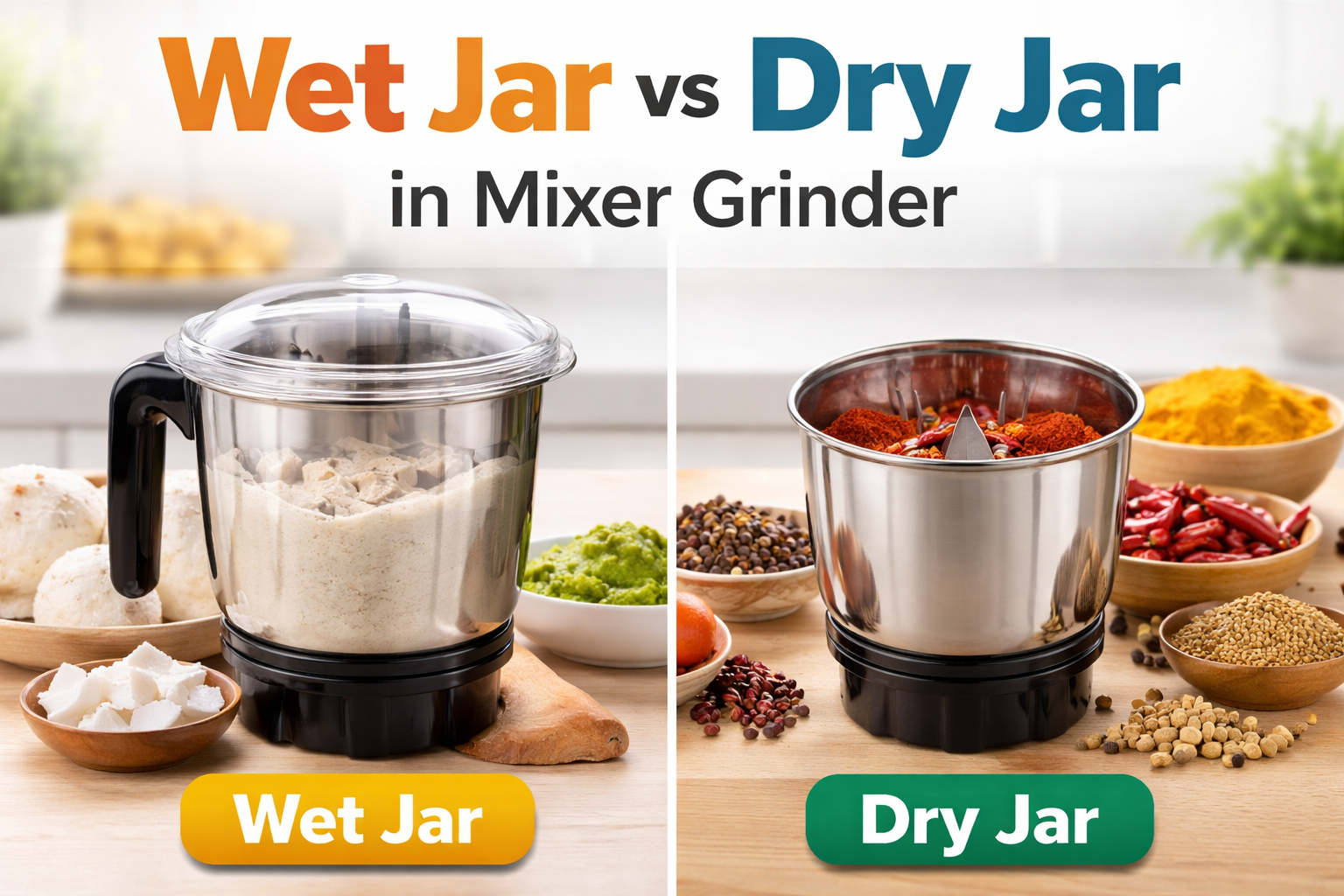
A wet jar is used for grinding ingredients that require water, such as dosa batter, chutneys, and pastes. A dry jar is designed for grinding dry ingredients like spices, coffee beans, and masala powders. Wet jars usually have wider bodies and curved blades, while dry jars have sharper blades for fast powder grinding.
The main difference between a wet jar and dry jar in a mixer grinder is the type of ingredients they handle.
Table of Contents
What Is a Wet Jar?
A wet jar is designed for grinding ingredients that contain moisture or require water during grinding.
These jars are commonly used when making thick pastes or batters that need smooth consistency.
Common uses of a wet jar
- Idli batter
- Dosa batter
- Coconut paste
- Tomato or onion paste
- Thick chutneys
Wet jars are designed to handle heavier mixtures that move slowly inside the jar.
If you are specifically looking for the correct jar for batter preparation, you can read our detailed guide on which jar to use for idli and dosa batter in a mixer grinder.
Typical features of a wet jar
- Wider jar body
- Slightly curved blades
- Better circulation for liquids
- Larger capacity compared to dry jars
Because of this design, wet jars allow ingredients to move more easily while grinding thick mixtures.
What Is a Dry Jar?
A dry jar is mainly used for grinding dry ingredients into powder or fine particles.
These jars are ideal when there is little or no moisture involved.
Common uses of a dry jar
- Grinding dry spices
- Making masala powders
- Coffee beans
- Sugar grinding
- Dry coconut powder
Dry jars usually focus on speed and sharp cutting action rather than handling thick mixtures.
Typical features of a dry jar
- Narrower jar shape
- Sharper blades
- Faster grinding action
- Designed for hard ingredients
This design helps break down solid ingredients into fine powders quickly.
Wet Jar vs Dry Jar – Main Differences
Wet Jar vs Dry Jar – Main Differences.
| Feature | Wet Jar | Dry Jar |
|---|---|---|
| Best For | Batter, chutneys, pastes | Spices, masala powders |
| Jar Shape | Wider | Narrow |
| Blade Type | Curved blades | Sharp cutting blades |
| Grinding Style | Smooth grinding | Fast powder grinding |
Although both jars are used for grinding, their design and purpose are quite different.
The table above shows the basic differences, but understanding how each jar behaves during grinding can help you use them more effectively.
Wet Grinding vs Dry Grinding
Wet grinding uses ingredients that contain moisture or require water, such as dosa batter, chutneys, and pastes. Dry grinding is used for spices, coffee beans, and masala powders where little or no liquid is involved. Because these grinding methods are different, mixer grinder jars are designed differently.
Wet Jar
- Designed for wet ingredients and batters
- Handles thick mixtures easily
- Wider shape for better movement of liquids
- Grinding speed is usually slower but smoother
Dry Jar
- Designed for dry ingredients and powders
- Faster grinding speed
- Strong cutting blades
- Works best with little or no water
Because of these differences, using the wrong jar may lead to poor grinding results.
Can You Use a Wet Jar for Dry Grinding?
Technically, yes. But it is not the best option.
When you grind dry spices in a wet jar, you may notice:
- Powder may not become very fine
- Grinding takes longer
- Ingredients may stick to the sides
The job may still get done, but the efficiency will not be as good as using a dry jar.
Can You Use a Dry Jar for Wet Grinding?
This is possible in some situations, but it may cause problems if the mixture is thick.
Possible issues include:
- Batter sticking to the jar walls
- Uneven grinding
- Overheating if the load is too heavy
- Poor texture in batters
Dry jars are not built for handling heavy wet mixtures like dosa batter.
Why Using the Correct Jar Matters
Using the correct jar is not only about better results. It also helps protect the mixer grinder.
When the right jar is used:
- Grinding becomes smoother
- Motor stress is reduced
- Energy is used more efficiently
- Jars and blades last longer
If the wrong jar is used repeatedly, it can lead to problems like dull blades, overheating, and unnecessary strain on the motor.
If your jar starts leaking or stops working properly, you may also want to check our guide on mixer grinder jar leaking – repair or replace.
How to Identify Wet Jar vs Dry Jar in Mixer Grinder
Most mixer grinders come with three common jars, and you can usually identify them easily.
Large jar
Usually used for wet grinding like batter and large quantities.
Medium jar
Typically used for dry grinding like spices and masala powders.
Small jar
Often used for chutneys or small quantities.
You can also check the shape and blade design to recognize the difference.
According to the appliance guide on mixer grinders, using the correct jar improves grinding efficiency and protects the motor.
Common Mistakes People Make
Many households unknowingly use mixer jars incorrectly. Some common mistakes include:
- Using one jar for every type of grinding
- Grinding thick batter in a dry jar
- Grinding spices in a wet jar
- Adding too much water during grinding
- Overloading the jar with ingredients
Avoiding these mistakes can improve grinding quality and extend the life of your mixer grinder.
My Recommendation
A simple rule works well for most kitchens:
- Wet jar for batters, pastes, and ingredients that require water
- Dry jar for spices, powders, and dry ingredients
- Small jar for chutneys and small grinding tasks
Following this basic rule helps the mixer grinder work more efficiently and produce better results.
If you are planning to buy a new mixer grinder, you can also explore our guide on best mixer grinders under ₹2000 in India for affordable options.
Final Thoughts
The difference between a wet jar and a dry jar in a mixer grinder mainly comes down to their design and purpose.
Wet jars are built to handle moist ingredients and thick mixtures, while dry jars are designed for fast grinding of dry ingredients and powders.
Using the right jar for the right task makes grinding easier, improves food texture, and helps your mixer grinder last longer.
Common Questions About Mixer Grinder Jars
Can the same jar be used for both wet and dry grinding?
In some situations, the same jar can be used for both wet and dry grinding, but it is not always ideal. Wet jars are designed for ingredients that require water, while dry jars work better for spices and powders. Using the correct jar usually gives better grinding results and protects the mixer grinder motor.
Which jar is best for chutney in a mixer grinder?
A small jar or chutney jar is usually best for making chutneys. These jars are designed for smaller quantities and allow ingredients to grind evenly without sticking to the sides.
Why does the mixer grinder have different jars?
Mixer grinders come with different jars because each grinding task requires a different design. Wet grinding needs a wider jar and curved blades for thick mixtures, while dry grinding works better with sharper blades that can quickly grind spices and powders.
Frequently Asked Questions
Can I skip one jar in a mixer grinder?
It is not recommended. Wet and dry jars serve different purposes, and having both makes the mixer grinder more useful.
Which jar is used most often?
For many households, the wet jar is used frequently for batters and pastes, while the dry jar is commonly used for spices.
Can both jars be washed the same way?
Yes. Both jars can be washed with normal dish soap and water. Just make sure the jars are dried properly after washing.