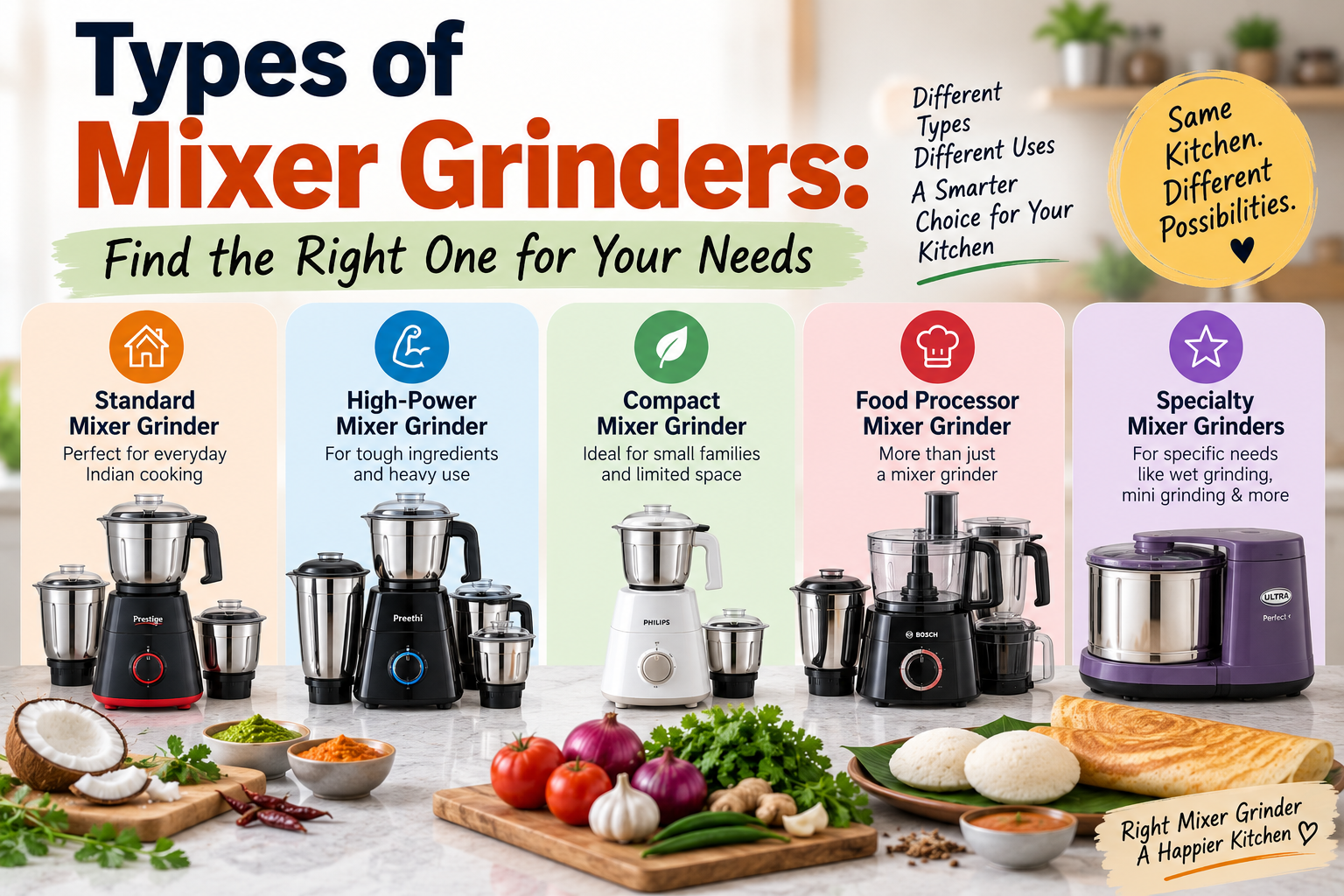
Walking into an appliance store to buy a mixer grinder can be overwhelming. You see dozens of options with different jars, power ratings, and price tags. Understanding the main types of mixer grinders makes choosing much easier. The types of mixer grinders available fall into three main categories.
Table of Contents
The Main Types of Mixer Grinders Explained
Dry Grinders: Dry Grinders: One of the types of mixer grinders, specifically designed for grinding dry ingredients. This type of mixer grinder is perfect for spices. Smaller, sharper blades, high speeds. Jar typically 0.5-1 liter.
Dry grinders use high-speed stainless steel blades designed to pulverize hard spices into fine powder.
Real-world example: You buy whole coriander seeds (₹40/100g), grind fresh in 2-3 minutes, use immediately. Store-bought powder costs ₹80/100g.
Wet Grinders: Handle wet ingredients—batters, chutneys, pastes. Larger jar (1.5-2L), more powerful motor, different blade design.
Real-world example: Sunday dosa batter takes 30 minutes manually; wet grinder does it in 5 minutes.
3-in-1 Mixer Grinders: Multiple jars (wet, dry, small chutney). Most versatile for most households. Best value for typical Indian kitchens.
Quick Comparison Table: Types of Mixer Grinders Side-by-Side
| Feature | Dry Grinder | Wet Grinder | 3-in-1 Mixer |
|---|---|---|---|
| Best for | Spice grinding | Batter making | Everything |
| Speed | Fast | Medium | Fast |
| Jar size | Small (0.5-1L) | Large (1.5-2L) | Multiple |
| Cost | ₹2,500-4,000 | ₹3,000-6,000 | ₹3,500-7,000 |
| Grinding dry items | Excellent | Good | Very good |
| Making batter | Limited | Excellent | Very good |
| Best for homes | Minimal grinding | Heavy batter | Most Indian homes |
Quick Decision Framework
How often do you grind spices?
- Every day? → Buy 3-in-1
- 2-3x/week? → Buy 3-in-1
- Rarely? → Skip or buy basic model
How often do you make batter?
- 3-4x/week (South Indian family)? → Consider dedicated wet grinder
- 1-2x/week? → 3-in-1 is fine
- Rarely? → 3-in-1 works
Bottom line: 90% of Indian homes should buy a 3-in-1 mixer grinder.
How to Choose: Key Factors
Power Rating: 500W (limited), 750W (perfect for home), 1000W+ (overkill for most). A 1000W doesn’t grind spices better than 750W. The practical difference is minimal.
Build Quality: More important than power. Check motor type, jar material (stainless steel > plastic), body weight (heavier = better construction), base stability (no excessive vibration).
Jar Quality: Good seal is crucial. Jar should fit snugly without excessive force. Stainless steel resists staining better than plastic.
Safety Features: Overload protector (protects motor), safety switch (prevents running without jar), proper insulation.
Warranty & Service: 1-2 year warranty standard. Can you get repairs done locally? Service network matters more than warranty period.
Motor Types: Copper vs Aluminum
Copper Motors:
- Cost more, last 5-7 years with regular use
- Handle heat better
- Better for daily grinding
Aluminum Motors:
- Cost less, may need replacement after 3-4 years
- Still reliable for typical home use
- Good for light-to-medium use
Real perspective: Over 10 years, you replace one motor. Choose based on your use frequency.
The motor converts electrical energy into mechanical motion, spinning the blades at 15,000-25,000 RPM depending on power.
Traditional Wet Grinder vs Modern Mixer
Traditional wet grinders produce slightly smoother texture (especially for idli batter). But they’re slow, take more space, require specific technique.
Modern mixer grinders trade some texture for speed and convenience. For practical family cooking, modern grinders are more practical.
Common Mistakes When Choosing
Buying cheapest: Compromises on motor quality, jar quality, durability. You’re not saving—you’re risking earlier failure.
Buying most expensive: Unnecessary for home cooking. Mid-range ₹4,000-6,000 models work excellently.
Not checking service network: Buying from brand with no local service centers is risky. You can’t get repairs done easily.
Ignoring jar quality: If jars don’t seal or stain immediately, that’s daily frustration. More important than motor eventually.
Underestimating storage needs: Most grinders are 10x7x7 inches. Verify you have space before buying.
Other Types Worth Knowing
Juicer Mixer Grinders: Include juicer jar for fruit/vegetable juice. Useful if juicing is regular.
Portable Mixer Grinders: Smaller, cordless. Convenient for quick tasks but less powerful.
Mixer + Food Processor: Combines grinding and chopping. Good if you need multiple functions.
Making Your Decision
Step 1: Decide capacity. Family of 4 needs 1.5-2L wet jar. Smaller or larger families adjust accordingly.
Step 2: Pick wattage. 750W for most households. Go higher only if grinding in bulk regularly.
Step 3: Choose type. For most homes, 3-in-1 is best value.
Step 4: Verify brand. Established brands with service networks in your city.
Step 5: Read reviews. Ask people who own the specific model.
Step 6: Test if possible. Try at friend’s house to feel sound, vibration, and performance.
FAQ
Q: Can one jar do wet and dry grinding? A: Technically yes, but not recommended. Wet jars absorb moisture and retain odors. Separate jars give better results.
Q: Is 500W enough or should I get 750W? A: For most homes, 750W is ideal. 500W may struggle with very hard ingredients.
Q: What’s the difference between stainless steel and plastic jars? A: Stainless steel lasts longer, doesn’t stain, doesn’t absorb odors. Plastic is cheaper but may stain and retain smells.
Q: How many jars should a good grinder have? A: Quality models typically come with 3: wet (1.5-2L), dry (0.75-1L), chutney (0.4-0.5L).
Q: Why do brands differ so much in price? A: Better motors, quality control, after-sales service, warranty. Established brands invest in durability.
Q: Should I buy separate dry and wet grinders or one 3-in-1? A: For 95% of homes, a 3-in-1 is practical. Buy separate only if you have heavy-duty, specific needs.
What You Now Know
- Three main types: dry grinders, wet grinders, 3-in-1 mixer grinders
- For most homes, 3-in-1 is best value
- 750W power handles most cooking
- Motor type and jar quality matter more than wattage
- Buying from brands with service networks in your area is important
Next Steps
Learn what a mixer grinder is → Article : What is a Mixer Grinder?
Decide if you need one → Article : Do You Really Need a Mixer Grinder?
See what you can make → Article : What Can You Make with a Mixer Grinder?