
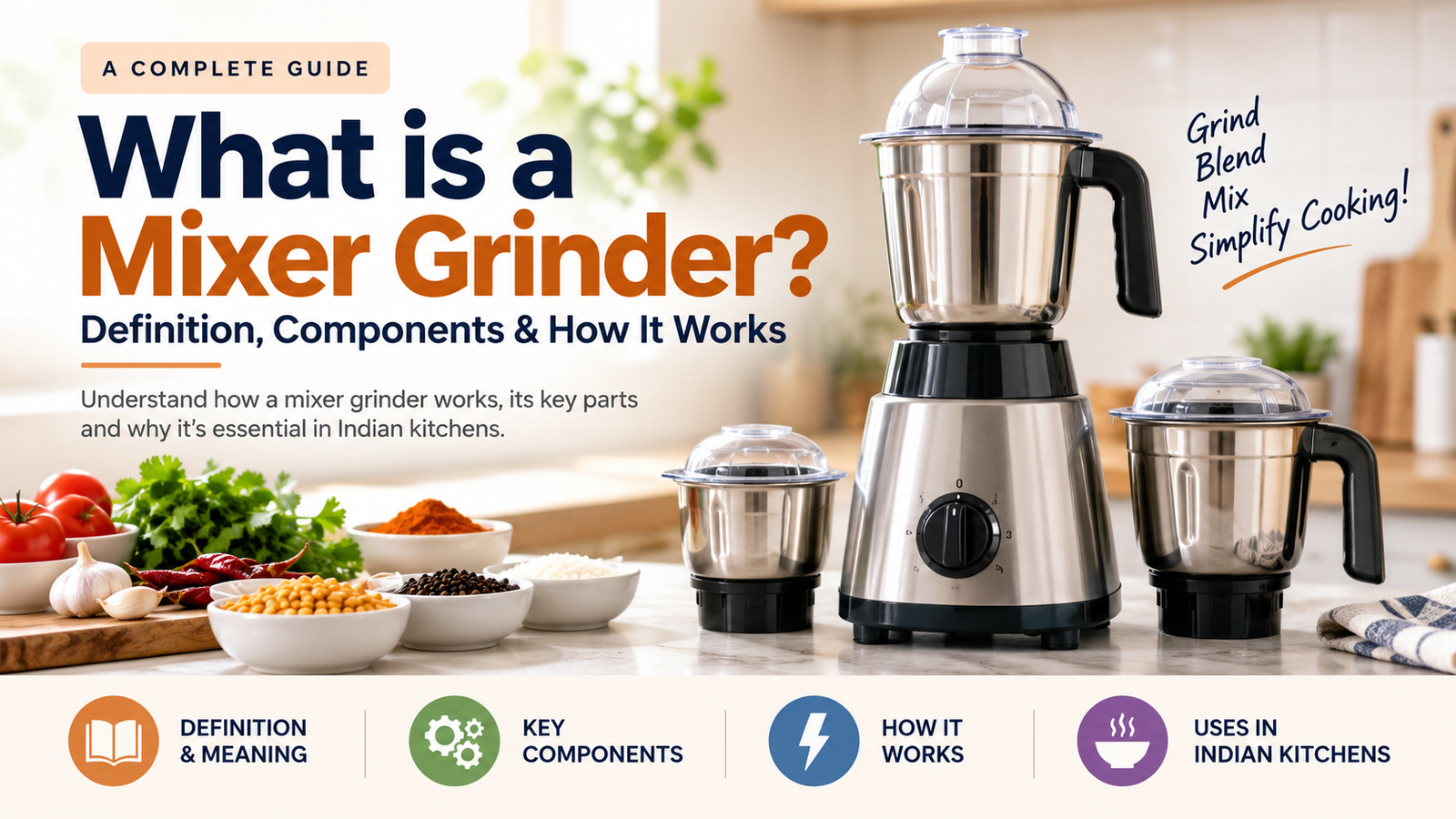
If you’ve ever stood in your kitchen trying to grind coconut by hand, or spent longer than you’d like making a smooth paste for your morning chutney, you know kitchen grinding can be time-consuming. A mixer grinder can change that.
This article explains what a mixer grinder is, how it works, and what makes it different from other kitchen appliances. No sales pitch—just the facts you need to understand this appliance. By the end, you’ll know exactly how a mixer grinder functions.
Table of Contents
What is a Mixer Grinder? Definition & Meaning
A mixer grinder (also called a “mixie”) is a kitchen appliance that combines grinding, blending, and mixing functions into one machine.
What does a mixer grinder do? You pour in your ingredients—whether dry spices, wet vegetables, or grains—and out comes exactly what you need: fine powders, smooth pastes, or perfectly mixed batters.
Why is it called “mixer grinder”? The “mixer” part refers to the mixing function, while “grinder” refers to grinding dry ingredients like spices. Together, the name describes the appliance’s dual purpose.
The key difference from other appliances: Unlike blenders (designed for liquids) or food processors (designed for chopping), a mixer grinder is built specifically to handle both dry spices and wet ingredients, making it ideal for Indian cooking traditions.
Quick Overview
Before diving into details, here’s what you need to know about a mixer grinder:
- A mixer grinder combines three functions: grinding, blending, and mixing
- Your mixer grinder handles both dry ingredients (spices) and wet ingredients (vegetables, batters)
- Every mixer grinder comes with multiple jars, each designed for different tasks
- It’s different from blenders and food processors (see comparison below)
Key Components: What’s Inside a Mixer Grinder?
A mixer grinder has five main parts. Understanding each one helps you appreciate how this appliance works.
1. The Motor (The Heart)
The motor converts electricity into mechanical energy that spins the blades. Motor quality is what determines durability—more important than wattage alone.
Mixer grinders use one of two motor types:
Copper-wound motors: More durable, handle continuous use better, but more expensive
Aluminum-wound motors: Lighter, more affordable, still reliable for typical home use
2. The Jars (Different Sizes for Different Tasks)
Most mixer grinders come with multiple jars because wet and dry grinding require different designs:
Wet Jar (1.5-2L): For liquids, vegetables, pastes, chutneys. Has flat blades optimized for smooth processing of a mixer grinder.
Dry Jar (0.75L): For spices, grains, and hard ingredients. Has cross-shaped blades for fine powder in your mixer grinder.
Chutney Jar (0.4-0.5L): For small batches of paste or powder. Compact and convenient for quick grinding with your mixer grinder.
You can make small adjustments if needed, but using the right jar for each task with your mixer grinder gives better results and prevents odor retention. Learn more about when to use each jar → Article : Types of Mixer Grinders
3. The Blades (The Working Part)
Blades are precision-made from stainless steel. Each blade design is optimized for its specific jar type in a mixer grinder:
Wet blade: Flat design that works efficiently with liquids and soft ingredients in your mixer grinder
Dry blade: Cross-shaped design that creates fine powder from hard spices in your mixer grinder
Blade maintenance: With regular use, blades in your mixer grinder may become less sharp and may eventually need replacement. Proper maintenance extends their lifespan in your mixer grinder.
4. The Body & Sealing
A sturdy plastic or metal body reduces vibration when the mixer grinder is running. The sealing mechanism uses a silicone gasket that fits between the jar and lid, preventing leaks during grinding in your mixer grinder.
A good seal is important because:
- Prevents batter or paste from leaking out of your mixer grinder
- Ensures efficient grinding (no escape of ingredients from mixer grinder)
- Keeps the base clean and protected from your mixer grinder
5. Safety Features
Mixer grinders include built-in safety protections:
Overload protector: Shuts off the motor if it overheats. This prevents motor burnout if you accidentally jam the machine or try to grind something too hard in your mixer grinder.
Safety interlock: Won’t run unless the jar is properly attached. This prevents accidents from blades spinning without a container in your mixer grinder.
Electrical insulation: Protects against electrical hazards during normal use of your mixer grinder.
Sturdy base with non-slip feet: Reduces vibration during operation and prevents tipping of your mixer grinder.
These features matter because they protect both the appliance and the user of your mixer grinder.
How a Mixer Grinder Works: Basic Principle
When you switch on a mixer grinder, the motor converts electricity into mechanical energy. This power spins blades at high speed inside the jar of your mixer grinder. This is how every mixer grinder operates.
The rotating blades create a circular motion that:
- Pushes ingredients toward the center of your mixer grinder
- Breaks them down through cutting and grinding action in the mixer grinder
- Transforms them into powder, paste, or batter using your mixer grinder
That’s the basic principle of how a mixer grinder works. The motor handles it all—whether you’re grinding hard spices, wet vegetables, or thick batters in your mixer grinder.
For the technical details about how the motor, electromagnetic force, and blade design work together at a deeper level, [see how mixer grinder works → FUTURE LINK: /how-mixer-grinder-works-technical/]
How Is a Mixer Grinder Different from a Blender or Food Processor?
A mixer grinder does different things than other appliances. Here are the key differences:
A blender’s capabilities vary by model, and some food processors have grinding attachments.
Use this more qualified comparison:
| Appliance | Typical use |
|---|---|
| Mixer grinder | Dry grinding, wet grinding, mixing |
| Blender | Liquids, smoothies, purees |
| Food processor | Chopping, slicing, shredding, and other food preparation tasks |
Note : capabilities vary by model and attachments.
Quick summary: A mixer grinder is built for grinding and mixing, blenders for liquids, food processors for chopping. They each do different jobs best.
Why Mixer Grinders Are Common in Indian Kitchens
Indian cooking relies on different ingredients and techniques than many other cuisines. This is why a mixer grinder has become essential in most Indian households. Most Indian families find a mixer grinder indispensable.
- We use whole spices that need grinding into powder using a mixer grinder
- We make fresh batters for dosas, idlis, and other dishes from scratch with mixer grinder
- We prepare fresh pastes and chutneys regularly using our mixer grinder
- We work with ingredients like coconut that require grinding with a mixer grinder
A mixer grinder is designed specifically for these tasks. It can grind hard spices, blend smooth batters, and make pastes—often in the same day. This is why a mixer grinder is standard in most Indian households.
This doesn’t mean everyone needs one. But it explains why mixer grinders are so popular in Indian cooking culture.
Safety Features Matter
Beyond the built-in safety features mentioned earlier, proper maintenance of your mixer grinder is also important for longevity and safe operation. A well-maintained mixer grinder lasts longer.
These features matter because they protect both the appliance and the user of your mixer grinder. [See maintenance guide and common problems → Troubleshooting articles]
Frequently Asked Questions About Mixer Grinders
Q: What is a mixer grinder used for?
A: A mixer grinder is used for everyday kitchen tasks. A mixer grinder helps with:
- Grinding spice powders (cumin, coriander, turmeric, etc.)
- Making chutneys and pastes (coconut, mint, ginger-garlic)
- Preparing batters for dosa, idli, and other dishes
- Blending smoothies and other drinks
- Grinding vegetables for sauces and gravies
For a complete list with real-world examples and time savings, see practical examples of what you can make → Article : What Can You Make with a Mixer Grinder
Q: How is a mixer grinder different from a blender?
A: Blenders are designed for liquids (smoothies, soups). A mixer grinder handles both wet and dry ingredients, plus hard spices. They use different blade designs and motor speeds optimized for different tasks. Unlike a blender, a mixer grinder is specifically built for this dual purpose. See the comparison table above for details on mixer grinder vs blender.
Q: What types of mixer grinders exist?
A: Understanding types of mixer grinders helps you choose correctly. There are three main types of mixer grinders:
- Dry grinders: Smaller machines designed only for grinding spices and dry ingredients
- Wet grinders: Larger machines designed for batters and pastes
- 3-in-1 mixer grinders: Full-featured machines that handle all tasks with different jars
For guidance on which type of mixer grinder is right for different situations, learn about types and how to choose → Article : Types of Mixer Grinders
Q: Can I use one jar for both wet and dry grinding in my mixer grinder?
A: Technically yes, but it’s not recommended for your mixer grinder. Wet jars absorb moisture and can retain odors. Having separate jars (wet, dry, small chutney) in your mixer grinder gives better results and makes maintenance easier.
Q: What power rating (wattage) should a mixer grinder have?
A: Most home mixer grinders range from 500W to 1000W. Here’s a general guide for choosing mixer grinder wattage:
- 500W: Limited power, okay for light grinding tasks
- 750W: Sweet spot for most households, handles everything you’ll throw at it
- 1000W+: Heavy-duty power, useful for bulk grinding or very hard ingredients
For detailed comparison of power levels and what’s actually needed for your kitchen in a mixer grinder, [see wattage explained → How Many Watts Mixer Grinder Is Good for Home? 500W vs 750W vs 1000W Guide]
Q: How long do mixer grinders last?
A: With proper maintenance, most mixer grinders last 5-7 years. The motor usually outlasts the blades. Lifespan of your mixer grinder depends on:
- Motor quality (copper vs aluminum)
- Frequency of use
- How well you maintain it
- What you grind (hard spices wear blades faster in mixer grinder)
For detailed durability information and when to replace parts in your mixer grinder, [see durability and lifespan guide → FUTURE LINK: /mixer-grinder-lifespan-durability/]
Q: What safety features should I look for in a mixer grinder?
A: Quality mixer grinders have:
- Overload protector – Prevents motor burnout if jammed in mixer grinder
- Safety interlock – Prevents running without jar attached to mixer grinder
- Proper insulation – Electrical safety in your mixer grinder
- Sturdy, non-slip base – Prevents tipping and vibration of mixer grinder
Q: Do I actually need a mixer grinder?
A: That depends on your cooking habits and lifestyle. It’s not essential for everyone to own a mixer grinder.
[Read Article : Do You Really Need a Mixer Grinder? → Do You Really Need a Mixer Grinder? An Honest Assessment] for a complete assessment of whether a mixer grinder makes sense for your kitchen.
What You Now Know About Mixer Grinders
A mixer grinder is a multi-purpose kitchen appliance that:
- A mixer grinder combines grinding, blending, and mixing functions
- Comes with multiple jars for different tasks
- Uses a motor-powered blade system for efficiency
- Has safety features to protect the motor and user
- Is common in Indian kitchens for specific cooking tasks
Understanding what a mixer grinder is helps you decide if one is right for your home.
What’s Next?
You now understand what a mixer grinder is and how it works. The next questions about your mixer grinder are:
“Do I actually need one?” This depends on your cooking habits, kitchen space, and lifestyle. [Read Article 2: Do You Really Need a Mixer Grinder? → /do-you-really-need-mixer-grinder/] for a complete honest assessment.
“What types exist and how do I choose?” [Read Article : Types of Mixer Grinders → Types of Mixer Grinders: Find the Right One for Your Needs] to learn about dry grinders, wet grinders, and 3-in-1 models, plus how to pick the right mixer grinder for your needs.
“What can I actually make with it?” [Read Article : What Can You Make with a Mixer Grinder? → What Can You Really Make With a Mixer Grinder? Real Uses You’ll Actually Do] for practical examples with time savings and real-world scenarios.
Explore specific topics:
- Problems Explained → Common problems and troubleshooting
- Wattage explained →How Many Watts Mixer Grinder Is Good for Home? 500W vs 750W vs 1000W Guide
- Motor types explained →FUTURE LINK /mixer-grinder-motor-copper-vs-aluminum/]
- Maintenance guide → FUTURE LINK /mixer-grinder-maintenance-care-guide/]